gambocco
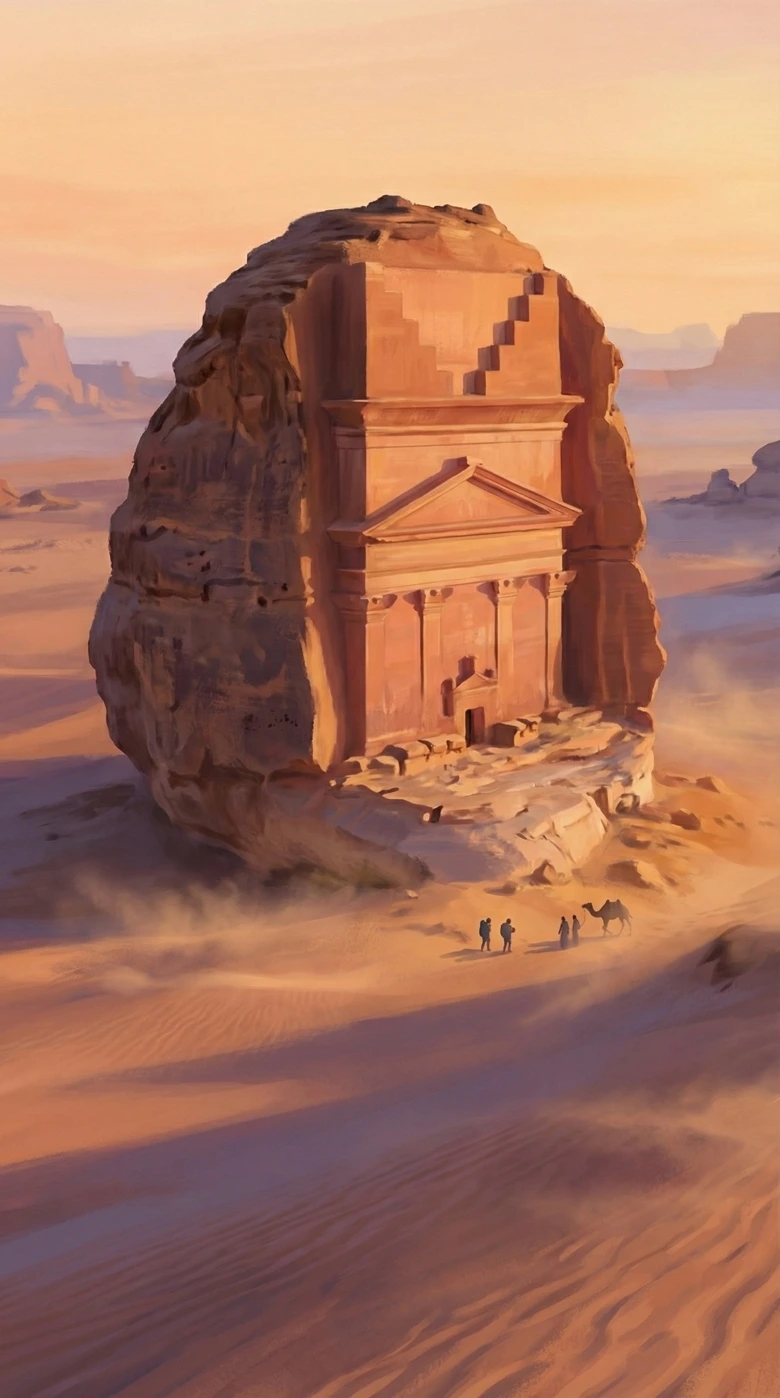
Hegra, AlUla
The story behind this piece
Hegra, AlUla is a digital painting that depicts the tomb of Lihyan, son of Kuza, at the ancient Nabataean site of Hegra in AlUla, Saudi Arabia. The composition shows the free-standing sandstone tomb rising alone from the desert plain in late light, with warm amber tones on the carved facade and long shadows across the sand. An AI-assisted digital artwork created as a unique edition for collectors, and as inspiration for digital artists shaping their next piece.
Hegra, also known as Mada'in Salih, is an ancient city in the desert of AlUla in northwestern Saudi Arabia, and in 2008 it became the country's first UNESCO World Heritage Site. It was the southern capital of the Nabataean kingdom, the same civilization that carved the city of Petra in Jordan, and it flourished between roughly the first century BC and the first century AD as a stop on the incense and trade routes across Arabia. More than a hundred monumental tombs survive, each carved directly from the sandstone outcrops. The tomb of Lihyan, son of Kuza — sometimes called Qasr al-Farid, "the lonely castle" — is the most famous: it was carved from a single free-standing block of stone, and unlike most Nabataean tombs it was never finished or used, standing apart from the others as a complete facade rising out of the plain.
It is listed for sale at rarible.com/gambocco, and the artist's page on that marketplace shows current availability and price. For those who admire the artwork but do not collect NFTs or Ordinals, the exact AI prompts used to create it are available to buy through ko-fi.com/gambocco.
Thank you for my first nft.@cabonsky1