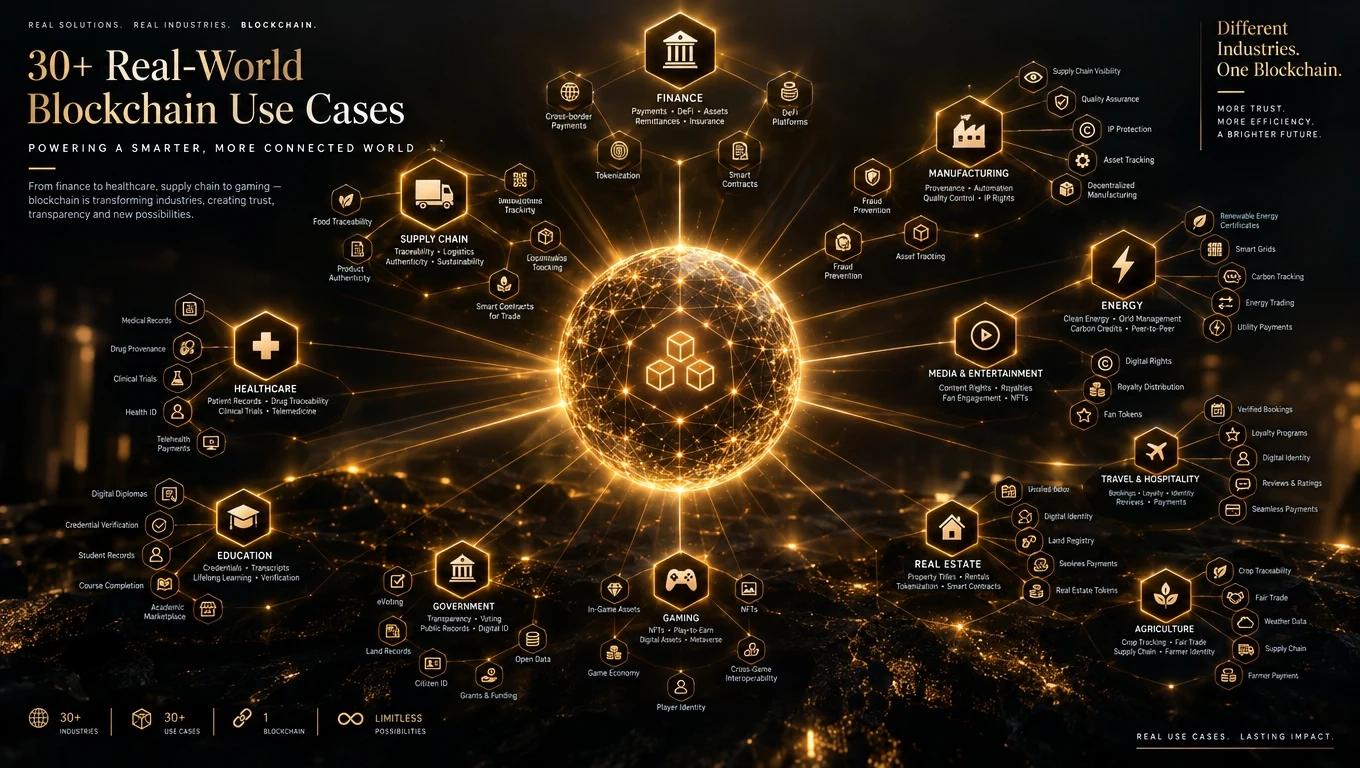
Blockchain has moved past hype and into measurable enterprise adoption. From global banks to humanitarian agencies, organizations are using distributed ledgers to cut costs, prove provenance, and remove intermediaries. Here are the most impactful, real-world examples shaping industries today.
Finance and Payments
- Cross-border remittances — Ripple's RippleNet processes payments for Santander, SBI, and over 300 financial institutions, settling transactions in seconds at a fraction of SWIFT's cost.
- Stablecoin settlement — Visa now settles certain merchant transactions in USDC directly on Ethereum and Solana.
- Tokenized treasuries — BlackRock's BUIDL fund surpassed $500M in tokenized U.S. Treasuries by mid-2024.
- DeFi lending — Aave, Compound, and Morpho collectively manage over $40 billion in on-chain loans.
- Bitcoin as legal tender — El Salvador (2021) and the Central African Republic experimented with state-level adoption.
Supply Chain and Logistics
- Food traceability — Walmart's IBM Food Trust traces leafy greens from farm to shelf in 2.2 seconds, down from 7 days.
- Luxury goods provenance — LVMH's Aura Blockchain Consortium authenticates Louis Vuitton, Prada, and Cartier products.
- Diamond certification — De Beers' Tracr platform tracks diamonds from mine to retail to combat conflict stones.
- Shipping logistics — Maersk's TradeLens (now sunset, but influential) digitized container documentation across 300+ ports.
- Pharmaceutical integrity — MediLedger verifies prescription drug authenticity for major U.S. pharma companies.
Healthcare
- Patient records — Estonia's KSI blockchain secures health records for over 1 million citizens.
- Clinical trial data — Pfizer and Boehringer Ingelheim have piloted blockchain to prevent trial data tampering.
- Medical credentialing — ProCredEx verifies healthcare provider credentials, reducing onboarding time by 60%.
Identity and Credentials
- Self-sovereign identity — Microsoft's ION on Bitcoin enables decentralized identifiers (DIDs).
- Academic credentials — MIT issues blockchain-verified diplomas; over 250 universities now use Blockcerts.
- Refugee identity — The UN's World Food Programme uses blockchain to deliver aid to Syrian refugees in Jordan.
Government and Public Sector
- Land registry — Sweden, Georgia, and Honduras have piloted blockchain land titles.
- Voting — West Virginia and Utah counties trialed blockchain-based mobile voting for overseas military.
- Public spending transparency — Colombia uses blockchain to track school meal procurement.
- e-Residency — Estonia's program lets entrepreneurs anywhere establish EU businesses on a blockchain-backed identity.
Energy and Sustainability
- Peer-to-peer energy trading — Brooklyn Microgrid lets neighbors trade rooftop solar power directly.
- Carbon credits — Toucan and KlimaDAO tokenize verified carbon offsets, bringing transparency to a historically opaque market.
- Renewable energy certificates — Energy Web Foundation partners with 100+ utilities globally.
Media, Art, and Entertainment
- NFT royalties — Platforms like Sound.xyz and Royal pay musicians directly via on-chain royalty splits.
- Film financing — Decentralized Pictures crowdfunds independent films through token-based investment.
- Photography provenance — Adobe's Content Credentials embed blockchain-verifiable metadata to combat deepfakes.
Gaming and Virtual Worlds
- Player-owned assets — Axie Infinity at peak generated $1.3 billion in revenue with millions of players in the Philippines and Venezuela.
- Esports prize transparency — Several tournaments now distribute prize pools via smart contracts.
Insurance
- Parametric insurance — Etherisc and Arbol issue automatic crop insurance payouts triggered by weather data oracles.
- Claims automation — AXA's Fizzy flight delay insurance pays passengers automatically when flights are delayed.
Emerging Frontiers
- AI training data provenance — Projects like Bittensor and Sahara use blockchain to track AI model contributions.
- DePIN (Decentralized Physical Infrastructure) — Helium has deployed 1M+ community-owned wireless hotspots.
- Decentralized science (DeSci) — VitaDAO funds longevity research through tokenized IP.
What These Examples Tell Us
Three patterns stand out across these use cases:
1. Blockchain wins where trust is expensive. Cross-border payments, supply chain verification, and credential validation all involve multiple parties who don't fully trust each other. Distributed ledgers replace expensive intermediaries.
2. Adoption is highest in permissioned settings. Many enterprise wins (Walmart, Maersk, IBM Food Trust) use private or consortium blockchains rather than public chains. Public chains dominate finance and consumer applications.
3. Tokenization is the wedge. From treasuries to carbon credits to art, representing real-world assets as on-chain tokens is the fastest-growing category. Boston Consulting Group projects tokenized assets to reach $16 trillion by 2030.
For more on where the technology delivers and where it doesn't, see our guide to benefits of blockchain technology and the blockchain in banking deep dive.
The Reality Check
Not every blockchain pilot succeeds. Maersk's TradeLens shuttered in 2022 due to insufficient industry buy-in. Many "blockchain for X" projects could have used a regular database. The successful examples share common DNA: a clear multi-party trust problem, willingness to share data, and economic incentives aligned through tokenization or fee reduction.
Blockchain in 2026 is no longer a question of "if" but "where." For builders, investors, and operators, the opportunity lies in identifying the specific friction points where decentralization genuinely outperforms centralized alternatives.
Disclaimer: Mentioned projects are examples, not endorsements. Always research current status and regulatory compliance in your jurisdiction.