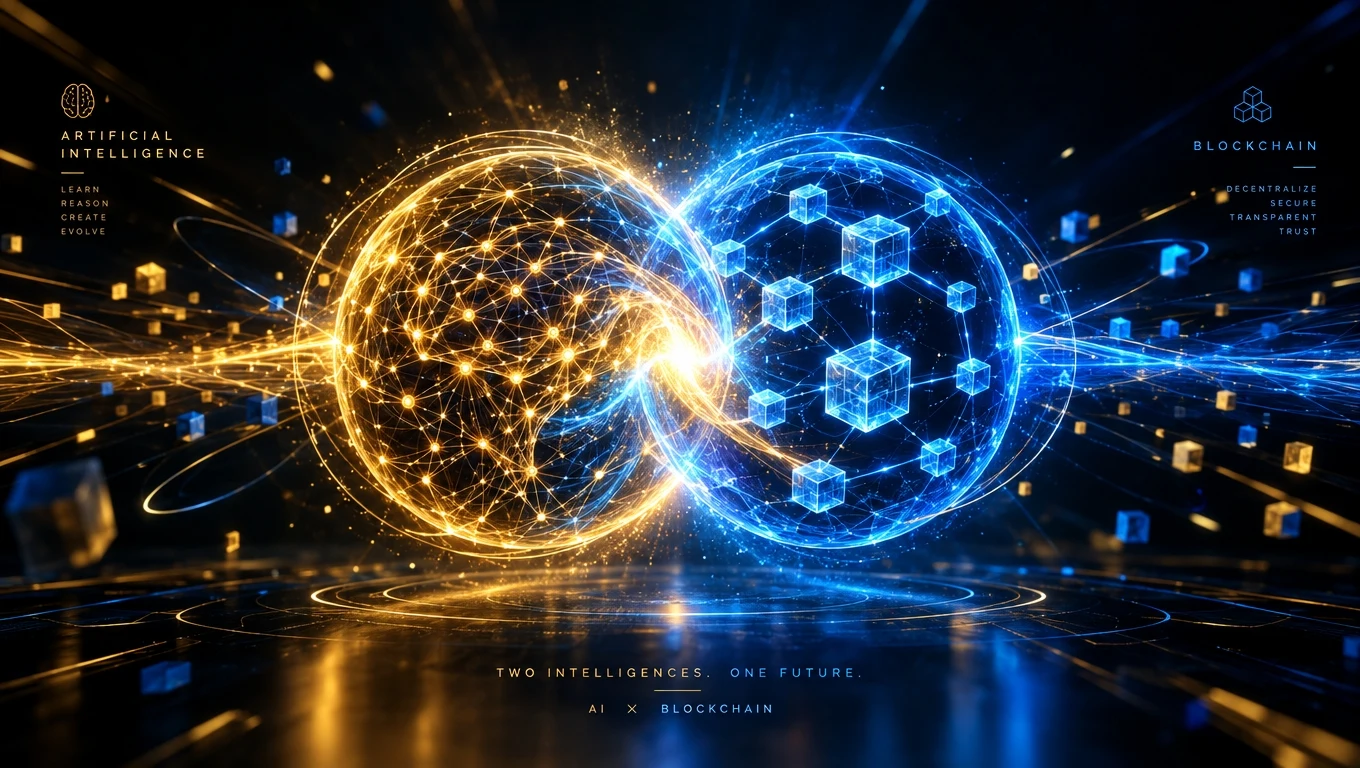
Two of the most transformative technologies of our era—artificial intelligence and blockchain—are increasingly intertwined. AI is moving fast and centralizing power in a handful of major labs. Blockchain offers decentralization, verification, and transparent coordination. Their convergence isn't a hype cycle; it's a structural response to real problems each technology creates for the other.
Why AI Alone Is a Problem
Modern AI systems—GPT-class models, image generators, agentic systems—have remarkable capabilities. They also have serious structural issues:
- Concentration: A handful of labs (OpenAI, Anthropic, Google, Meta, xAI) control the frontier
- Opacity: Users can't verify what data trained a model or what processes generated an output
- Provenance gap: AI-generated content is increasingly indistinguishable from human-created content
- Trust problem: As AI gets more powerful, individuals struggle to verify AI claims
- Compute concentration: Training requires hyperscale data centers controlled by a few cloud providers
Each problem creates risks: market concentration, manipulation potential, deepfake fraud, misinformation, and infrastructure fragility.
Why Blockchain Alone Is Limited
Blockchain has its own constraints:
- User experience friction keeps adoption mostly in financial use cases
- Most "real-world" data entering blockchains is unverified
- Manual coordination of complex decisions is slow
- AI-driven products mostly bypass blockchain rails today
The two technologies have complementary strengths that fix each other's weaknesses.
Where AI and Blockchain Converge
1. Decentralized AI Compute
Training and running modern AI models requires massive compute power. Centralized hyperscalers dominate this market, with corresponding pricing power. Decentralized compute networks are emerging:
- Render Network coordinates global GPU capacity for AI and rendering workloads
- Akash Network offers decentralized cloud computing
- io.net aggregates GPU clusters specifically for AI workloads
- Bittensor rewards nodes for contributing AI model intelligence to a shared network
These networks won't replace AWS for everything, but they're already serving real workloads at competitive prices, with users benefiting from lower costs and providers earning income on idle hardware.
2. AI Training Data Provenance
Lawsuits against AI labs over training data have proliferated. The core issue: AI models train on internet data without clear consent, attribution, or compensation for creators.
Blockchain-based data provenance addresses this:
- Sahara AI uses on-chain attestations to track training data contributions and pay contributors
- Adobe's Content Credentials embed blockchain-verifiable metadata in images
- Ocean Protocol marketplaces let data providers sell access with verifiable terms
- Story Protocol enables programmable IP licensing for AI training
When training data provenance is recorded on-chain, attribution and compensation become enforceable.
3. Verifiable AI Outputs
How do you know a piece of content was generated by AI, by a specific human, or modified after creation? Blockchain combined with cryptographic signatures provides answers:
- C2PA standard (backed by Adobe, Microsoft, BBC, others) attaches signed provenance to media
- Reality Defender, Truepic use blockchain anchoring for authenticity verification
- Decentralized identity standards let creators sign their work with portable credentials
As AI-generated content explodes, on-chain authenticity verification becomes essential infrastructure. See also our guide to blockchain proof of authenticity for businesses.
4. AI Agents With On-Chain Wallets
Autonomous AI agents are becoming a major transaction category. These agents need ways to pay for services, hold value, and interact with other software. Blockchain wallets are uniquely suited:
- Agents can hold and spend funds without requiring human approval for each transaction
- Smart contracts let agents commit to and execute conditional logic
- On-chain reputation lets users assess agent trustworthiness
Projects like Coinbase's AgentKit, Anthropic's MCP integrations, and various AI-native L1s are building infrastructure for this convergence. By 2026, AI agent transactions are a meaningful share of certain blockchain traffic.
5. Decentralized Model Marketplaces
Bittensor's "subnets" function as decentralized markets where AI models compete to provide intelligence. Contributors earn TAO tokens proportional to the quality of their model's outputs. This creates an economic alternative to closed-source model APIs.
Other approaches include:
- Ritual for verifiable AI inference on-chain
- Modulus Labs using zero-knowledge proofs to verify AI computations
- Ora providing on-chain AI oracle services
6. Identity in an AI World
As AI makes impersonation trivially easy—voice cloning, deepfakes, AI-generated text—proof of humanity becomes valuable. Blockchain-based identity helps:
- World ID uses iris biometrics combined with zero-knowledge proofs to verify unique human status
- Polygon ID issues verifiable credentials
- ENS, Lens, Farcaster identifiers provide portable, persistent identity
"Are you real?" becomes a question only blockchain-anchored identity can answer credibly at scale.
7. AI-Assisted Blockchain Operations
The convergence flows both ways. AI improves blockchain too:
- AI-assisted smart contract security audits catch vulnerabilities humans miss
- AI agents help users navigate complex DeFi strategies
- AI analyzes governance proposals and summarizes them for voters
- Machine learning improves blockchain analytics and fraud detection
Why This Convergence Matters
Three interlocking forces drive the AI-blockchain merger:
1. Trust deficit: As AI grows more powerful, society's ability to trust AI claims declines. Blockchain provides verifiable, tamper-resistant alternatives.
2. Power concentration: AI concentrates power in a few labs. Blockchain offers decentralized alternatives for compute, data, and model deployment.
3. Economic coordination: AI generates value that needs to flow to many parties (data providers, model creators, compute suppliers). Blockchain handles micropayments and programmable revenue splits.
Real Challenges Ahead
The convergence isn't without obstacles:
- Performance gaps — decentralized AI compute is still slower than top hyperscalers for largest workloads
- UX complexity — most users don't want to manage wallets, gas, and seed phrases
- Regulatory uncertainty — AI regulation (EU AI Act, U.S. executive orders) and crypto regulation are still evolving separately
- Energy concerns — both AI training and proof-of-work blockchains consume significant power
These are engineering and policy problems, not fundamental obstacles.
The Path Forward
Watch three developments:
- AI agent economies scale, with autonomous agents transacting trillions in value annually by 2030
- Content provenance becomes mandatory in some jurisdictions, anchored by blockchain timestamps
- Decentralized AI compute captures meaningful market share from hyperscalers for specific workload categories
AI and blockchain aren't competing visions of the future. They're complementary infrastructure layers solving different problems—and increasingly, each other's. The companies and projects building at this intersection are positioned to define the next decade of digital technology.
Disclaimer: AI and blockchain technologies evolve rapidly. Always evaluate specific implementations against current security, regulatory, and performance standards.