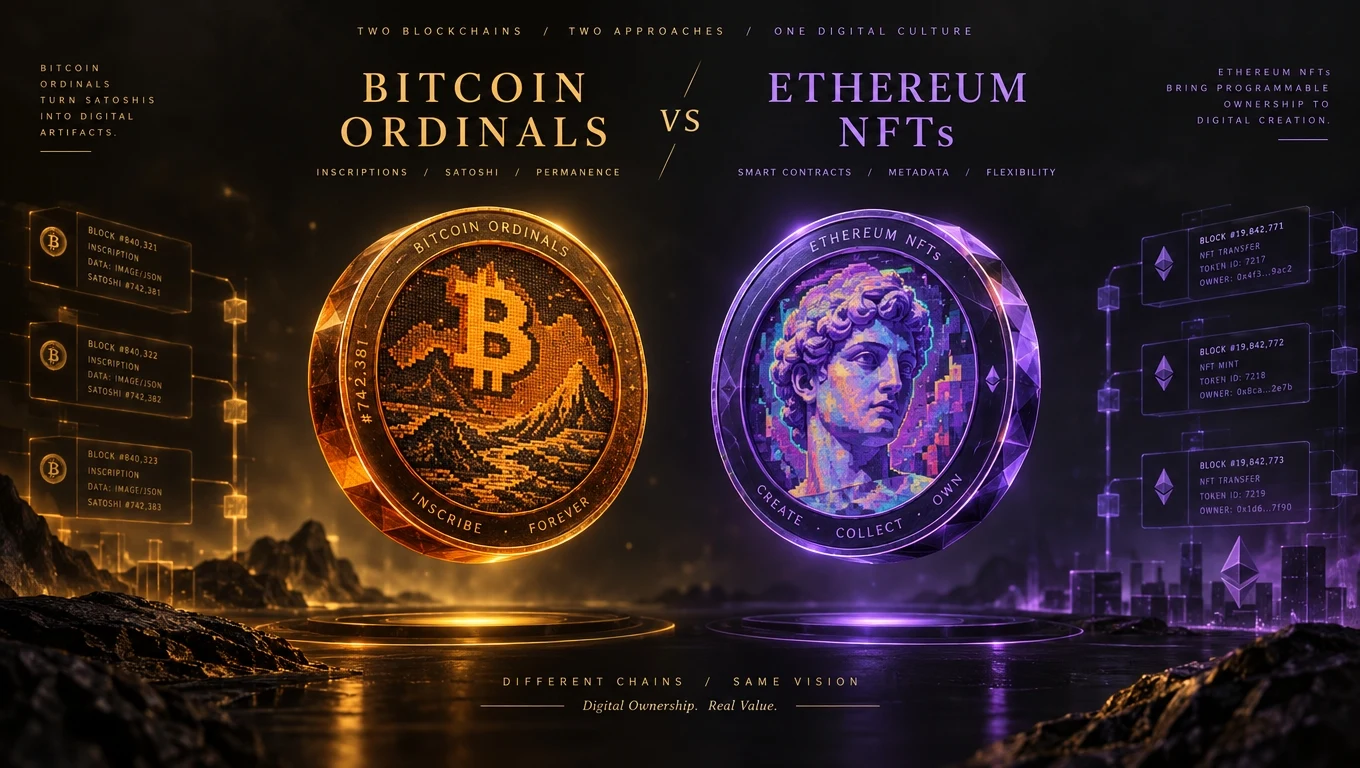
What Are Bitcoin Ordinals?
Launched in January 2023 by developer Casey Rodarmor, Ordinals inscribe data (images, text, audio, even small video files) directly onto individual satoshis — the smallest unit of Bitcoin. Because the content lives natively on Bitcoin's base layer, Ordinals inherit Bitcoin's full security model and 15+ years of network battle-testing.
Key characteristics:
- Fully on-chain storage — the artwork itself sits inside Bitcoin blocks.
- No smart contracts — Ordinals don't rely on programmable logic.
- Numbered by satoshi index — each inscription gets a unique ordinal number.
- BRC-20 tokens built on the same standard expanded the ecosystem in 2023–2024.
As of early 2026, over 80 million inscriptions have been created, with total fees paid to Bitcoin miners exceeding $450 million according to Dune Analytics.
What Are Ethereum NFTs?
Ethereum NFTs, defined primarily by the ERC-721 and ERC-1155 standards, have been the dominant NFT format since CryptoKitties launched in 2017. They rely on smart contracts that track ownership while the artwork itself usually lives off-chain on IPFS, Arweave, or centralized servers.
Key characteristics:
- Smart contract-driven — programmable royalties, traits, and utility.
- Mostly off-chain media — only a pointer to the image is stored on-chain.
- Massive marketplace infrastructure — OpenSea, Blur, Magic Eden, Rarible.
- Layer-2 scaling via Base, Arbitrum, and Polygon reduces gas costs.
Head-to-Head Comparison
Storage and Permanence
Bitcoin Ordinals win on permanence. Because data is embedded directly in Bitcoin, an Ordinal cannot break if a server goes offline. Ethereum NFTs typically reference external storage, which means some early NFTs have already suffered "link rot" when their hosts disappeared. Newer Ethereum projects increasingly use Arweave for permanent storage to close this gap.
Cost
Ethereum NFTs on Layer-2s like Base or Arbitrum now cost pennies to mint. Bitcoin Ordinals fluctuate with mempool congestion — during 2023's peak, inscribing a 1MB image cost over $500 in fees.
Royalties
Ethereum pioneered creator royalties, though many marketplaces have moved to optional royalty enforcement. Ordinals natively have no royalty mechanism — any secondary sale yields nothing to the original artist unless marketplaces voluntarily enforce a fee.
Functionality
Ethereum NFTs can be staked, fractionalized, used as collateral in DeFi, or grant access to gated experiences. Ordinals are simpler — closer to digital trading cards than programmable assets.
Cultural Positioning
Ordinals attract Bitcoin maximalists, traditional collectors, and those who value provenance over utility. Ethereum NFTs remain home to PFP communities (CryptoPunks, BAYC), generative art (Art Blocks), and experimental utility projects.
Real-World Examples
- Ordinals: Casey Rodarmor's inscription #0, NodeMonkes (which sold for over 26 BTC in 2024), and Yuga Labs' TwelveFold collection demonstrated institutional interest in Bitcoin-native art.
- Ethereum NFTs: Beeple's "Everydays: The First 5000 Days" sold at Christie's for $69 million in 2021. Pak's "Merge" generated $91.8 million across 28,983 collectors.
Which Is Better for Digital Art?
It depends on the artist's priorities:
Choose Bitcoin Ordinals if you value:
- Maximum permanence and on-chain purity
- Association with Bitcoin's brand and security
- Simpler, collectible-style assets
Choose Ethereum NFTs if you value:
- Lower minting costs (on L2s)
- Built-in royalties and programmable utility
- Established marketplace liquidity and collector base
Many leading artists now mint on both chains to maximize reach — Refik Anadol, XCOPY, and Damien Hirst have all released cross-chain editions.
The Future of NFT Art
The Bitcoin vs Ethereum debate is increasingly a false binary. By 2026, cross-chain bridges, Bitcoin Layer-2s like Stacks and Citrea, and Ethereum's continued L2 scaling have blurred the lines. Tools like the Runes protocol (also from Rodarmor) bring fungible token logic to Bitcoin, while Ethereum's account abstraction makes onboarding new collectors easier than ever.
For collectors, diversification across both ecosystems is the prudent strategy. For artists, the chain choice should follow the artwork's needs: permanence-first work belongs on Bitcoin; interactive or utility-driven art belongs on Ethereum. The future of NFT art isn't one chain winning — it's the maturation of digital ownership across multiple, complementary networks.