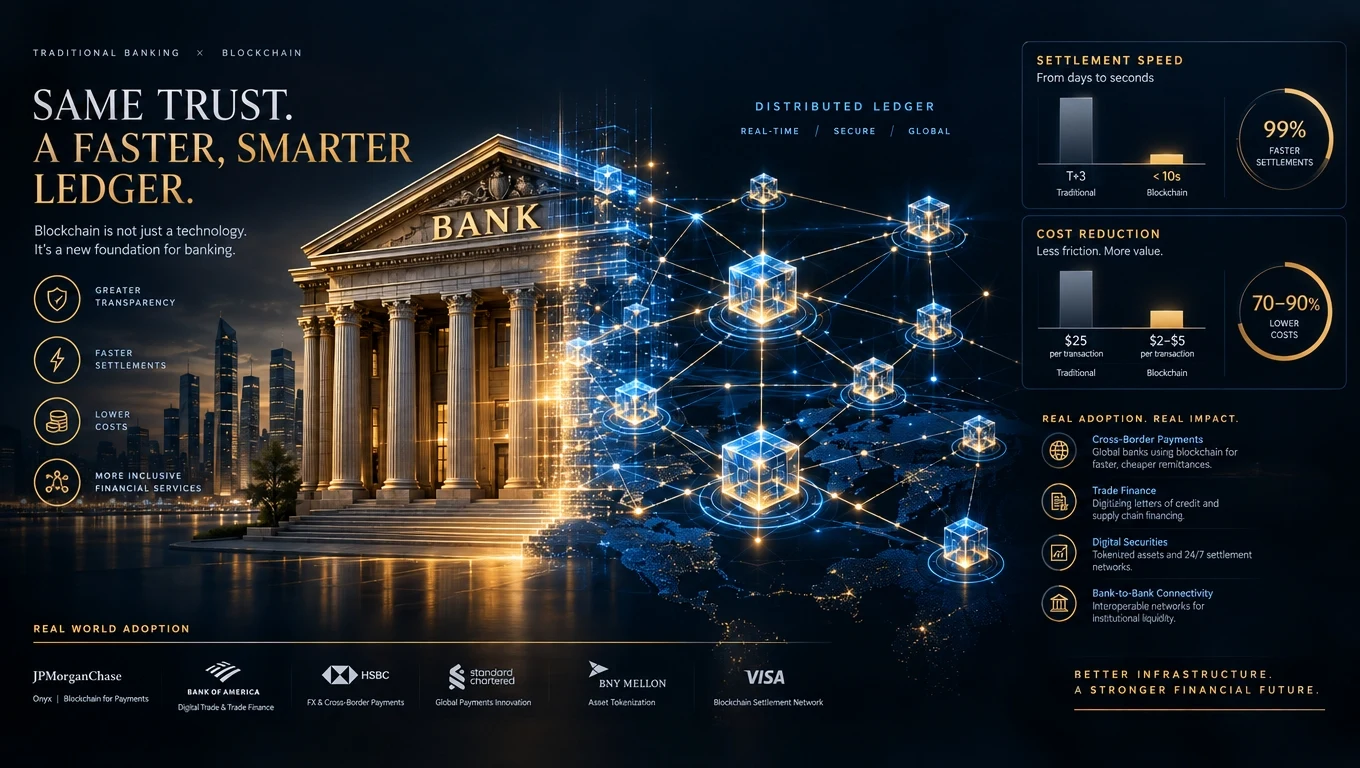
The banking sector has moved from skepticism to strategic adoption of blockchain technology. Once dismissed as a threat to traditional finance, distributed ledger technology now underpins billions of dollars in daily settlements at the world's largest banks. Understanding the benefits, challenges, and real-world implementations reveals how blockchain is reshaping financial services from the inside out.
How Blockchain Is Already Embedded in Banking
While retail crypto often dominates headlines, the most significant banking adoption has happened quietly within institutional infrastructure:
- JPMorgan's Onyx settles billions daily in intraday repo transactions using blockchain
- HSBC's FX Everywhere has processed over $4 trillion in foreign exchange settlements on a private blockchain
- Goldman Sachs offers tokenized money market funds and digital asset custody
- BNY Mellon launched institutional digital asset custody services
- Citi runs Citi Token Services for institutional payments and trade finance
- DBS Bank in Singapore operates a fully licensed digital exchange and crypto custody platform
These aren't experiments. They're production systems processing real customer transactions.
Key Benefits Blockchain Brings to Banking
1. Settlement Speed
Traditional cross-border bank transfers settle in 1-5 business days via correspondent banking. Blockchain settlement happens in seconds to minutes. JPMorgan's Onyx delivers near-instant settlement for repo trades that previously took T+1. This frees up trillions in working capital previously locked in settlement floats.
2. Cost Reduction
McKinsey research suggests blockchain can reduce trade finance processing costs by up to 50% and B2B cross-border payment costs by 40-80%. The savings come from:
- Eliminating reconciliation between counterparties
- Reducing fraud and chargeback losses
- Automating compliance audit trails
- Removing intermediaries from settlement chains
3. Enhanced Security
Cryptographic verification makes blockchain-recorded transactions tamper-evident. Combined with multi-signature controls and hardware security modules, this provides security guarantees stronger than traditional ledger systems. IBM's 2024 Cost of a Data Breach report found organizations with blockchain-secured infrastructure experienced 27% fewer breach incidents.
4. Transparent Audit Trails
Every transaction is immutably recorded with timestamps and counterparty identifiers. This transforms audit and compliance processes—regulators can query data directly rather than relying on bank-prepared reports. Several central banks now run real-time monitoring nodes on bank-operated private blockchains.
5. Programmable Money
Smart contracts automate financial logic. Loan repayments, collateral management, dividend distributions, and even regulatory reporting can execute automatically when predefined conditions are met. The Bank for International Settlements estimates programmable money could automate up to $4 trillion in annual global business processes.
6. Tokenization of Assets
Banks are tokenizing money market funds, treasuries, private credit, and even traditional deposits. BlackRock's BUIDL fund surpassed $500M in tokenized U.S. Treasuries. JPMorgan's tokenized deposit accounts let institutional clients move money 24/7 across global subsidiaries.
7. Financial Inclusion
For the 1.4 billion unbanked adults globally, blockchain-based services offer access without traditional banking infrastructure. While this is more visible in fintech than incumbent banks, several major banks now offer products targeting underbanked segments through mobile-first, blockchain-backed platforms.
Major Challenges Banks Face
1. Regulatory Uncertainty
Despite recent clarity from MiCA in Europe, U.S. stablecoin legislation, and Singapore's MAS framework, regulations vary widely by jurisdiction. Global banks must navigate dozens of regulatory regimes simultaneously, with rules still evolving in many markets.
2. Integration With Legacy Systems
Banks run mission-critical infrastructure dating to the 1970s and 1980s. Integrating blockchain rails with COBOL-based core banking systems requires substantial engineering investment. Most successful implementations use middleware to bridge the two worlds rather than replacing legacy systems wholesale.
3. Talent Shortage
Blockchain engineers with banking domain expertise remain scarce. Banks compete with crypto-native firms and tech giants for the same talent pool, often paying significant premiums.
4. Privacy and Confidentiality
Public blockchains are transparent by design, which conflicts with banking confidentiality requirements. Banks have addressed this through:
- Permissioned blockchains (Hyperledger Fabric, Corda, Quorum)
- Zero-knowledge proofs for selective disclosure
- Hybrid architectures combining public chains with private data layers
5. Interoperability
The blockchain ecosystem is fragmented across many chains and standards. Banks face decisions about which ecosystems to support and how to handle cross-chain transactions. SWIFT, Chainlink, and various interoperability protocols are working to standardize this.
6. Counterparty Risk in New Forms
Blockchain creates new risk vectors: smart contract bugs, oracle failures, bridge exploits, key management failures. Banks need new risk frameworks distinct from traditional credit and market risk.
7. Customer Education
Retail-facing blockchain products require significant customer education. Self-custody, seed phrases, and gas fees confuse most users. Banks investing in this space are spending substantially on UX simplification and customer support.
Real-World Implementation Patterns
Successful bank blockchain projects share common characteristics:
- Narrow scope — start with one specific use case (FX settlement, trade finance, repo)
- Consortium models — multiple banks share infrastructure rather than build separately
- Permissioned architecture — control over participants and data visibility
- Regulatory engagement early — involving supervisors from project inception
- Integration over replacement — adding blockchain capabilities to existing workflows
The Strategic Question for Banks
The question facing banks in 2026 isn't whether to adopt blockchain—it's how to position relative to:
- Crypto-native firms (Circle, Coinbase, Anchorage) that offer regulated digital asset services
- Tech giants (PayPal, Block, Apple) integrating crypto into payments
- Fintechs building on blockchain rails from day one
- Central bank digital currencies that may transform monetary infrastructure
Banks that move too slowly risk disintermediation by crypto-native competitors. Banks that move too aggressively risk regulatory backlash and operational missteps. The winners are finding the middle path—deploying blockchain selectively where it solves real problems while maintaining trust and compliance.
For the wider enterprise picture, see our analysis of blockchain in the banking sector and the financial transparency deep dive.
The Path Forward
By the end of this decade, blockchain will likely be invisible infrastructure beneath most financial services—the way TCP/IP became invisible beneath modern internet applications. Customers won't ask whether their bank uses blockchain any more than they ask whether their bank uses fiber optic cables. They'll just expect faster settlement, lower costs, and 24/7 service.
For banks, the strategic imperative is clear: build the capabilities now, while the competitive landscape is still forming.
Disclaimer: Banking adoption of blockchain involves regulatory complexity. This article is educational and not financial or legal advice.