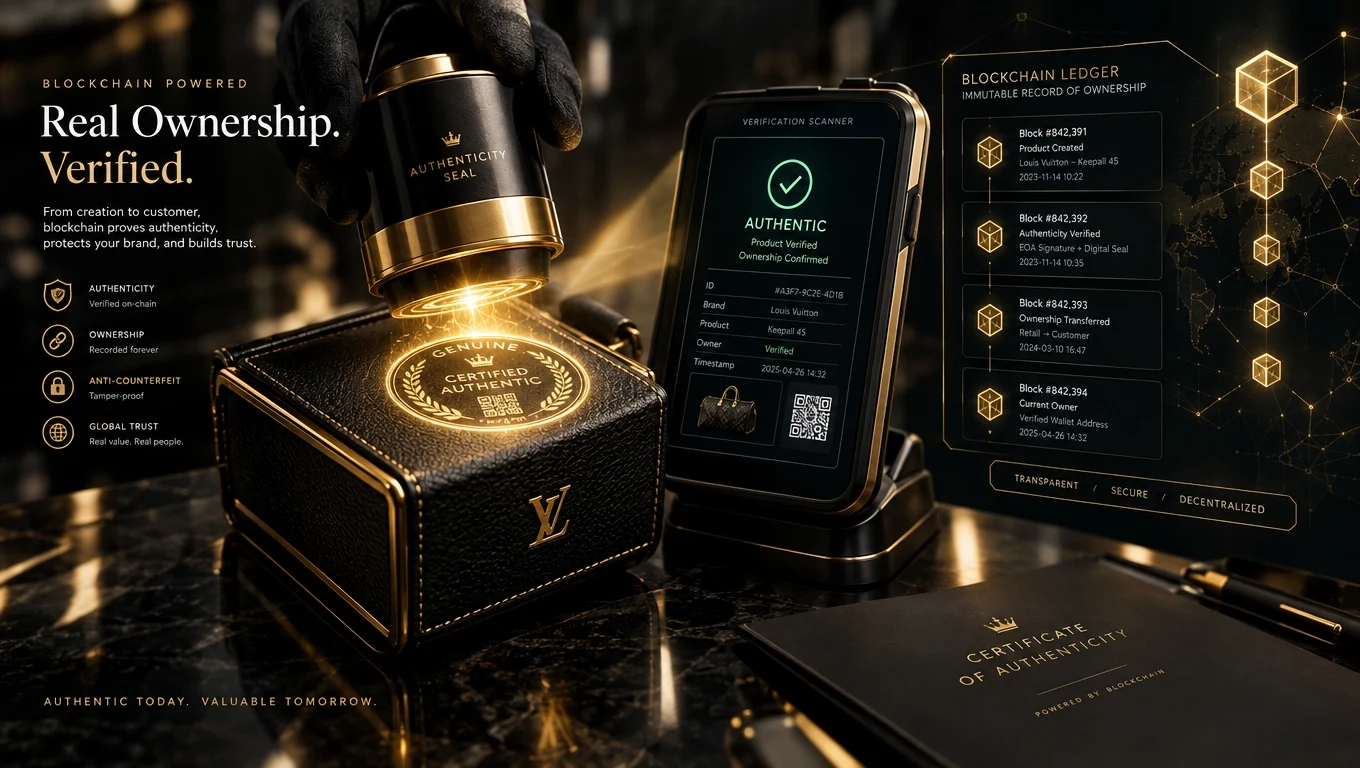
Counterfeit goods cost the global economy over $500 billion annually, according to the OECD. Digital piracy, fraudulent credentials, and supply chain manipulation add billions more. Blockchain-based proof of authenticity is emerging as one of the most effective business tools to combat these problems—and adoption has moved from pilots to production across luxury, pharmaceuticals, art, and beyond.
What Is Blockchain Proof of Authenticity?
Blockchain proof of authenticity uses cryptographic records and distributed ledgers to confirm:
- What an asset is (its specifications, origin, manufacturing date)
- Who owns it (current and historical owners)
- Whether it's genuine (issued by a verified party, not counterfeited)
Unlike paper certificates that can be forged or centralized databases that can be hacked, blockchain records are tamper-evident and globally verifiable. Anyone with internet access can confirm an item's provenance without trusting a central authority.
The mechanism typically involves three components:
- A unique digital token (often an NFT) representing the physical or digital item
- Cryptographic signatures from the issuing authority (manufacturer, gallery, certifying body)
- A public blockchain anchoring the record so it can't be quietly altered
Why Businesses Need This Now
Three pressures are driving rapid adoption:
1. Counterfeit Volume Is Exploding
Global counterfeit and pirated goods are growing faster than legitimate trade. Online marketplaces have made fakes accessible to consumers worldwide. Traditional anti-counterfeit measures—holograms, special inks, batch numbers—are increasingly easy to replicate.
2. Consumers Demand Provenance
Younger consumers in particular care about ethical sourcing, sustainability, and authenticity. Surveys consistently show willingness to pay premiums for verifiable provenance, particularly in luxury, fashion, food, and gemstones.
3. Regulatory Requirements
The EU's Digital Product Passport regulations require detailed provenance for textiles, batteries, electronics, and other categories starting in phases through 2027. Pharmaceutical track-and-trace mandates in the U.S. (DSCSA), EU (FMD), and elsewhere require serial-level traceability. Blockchain provides natural infrastructure for compliance.
Real-World Applications
Luxury Goods
The Aura Blockchain Consortium, founded by LVMH, Prada, Cartier, OTB Group, and Mercedes-Benz, has become the dominant luxury authentication platform. Customers can scan products to verify authenticity, view crafting history, and confirm ownership chains. Major brands like Louis Vuitton, Tiffany, Hublot, and Dior issue blockchain-anchored certificates for high-value items.
Fine Art
Beyond NFTs, blockchain authenticates physical artwork:
- Verisart issues blockchain certificates for galleries and artists
- Arianee provides authentication for art, watches, and other collectibles
- Maecenas, Masterworks, Particle tokenize fractional ownership of physical art
- Pak's "Lost Poets" demonstrated complex multi-stage authenticated drops
When a Picasso, Banksy, or contemporary work changes hands, blockchain records create permanent provenance trails that traditional certificates of authenticity can't match.
Pharmaceuticals
MediLedger authenticates prescription drugs across the U.S. pharmaceutical supply chain, with participating companies including Pfizer, Genentech, and major distributors. Each unit is serialized and tracked from manufacture to pharmacy, making counterfeit drugs significantly harder to introduce.
Diamonds and Gemstones
De Beers' Tracr platform records diamonds from mine to retail, providing assurance against conflict stones and synthetic substitutes. Over 2 million diamonds have been registered. Everledger extends similar tracking to colored gemstones, gold, and other precious materials.
Wine and Spirits
Premium wine and spirits authentication uses blockchain to combat sophisticated counterfeiting. Companies like EY's TATTOO wine tracing and Penfolds' authentication system record vintages, vineyard origin, and bottling details. Each bottle gets a tamper-evident seal linked to its blockchain record.
Academic Credentials
Counterfeit diplomas are a global problem. Blockchain credentials make verification trivial:
- Blockcerts standard is used by MIT, Harvard, and 250+ universities
- Hyland Credentials and Parchment offer enterprise verification platforms
- Several countries (Bahrain, Malta) have national blockchain credential systems
Employers can verify a candidate's degree in seconds without contacting the issuing institution.
Supply Chain Provenance
Beyond luxury and pharma, blockchain authenticates:
- Food (organic claims, country of origin, allergen tracking)
- Sustainable timber (FSC-certified wood tracking)
- Conflict minerals (tungsten, tantalum, tin, gold tracking)
- Fair trade products (coffee, cocoa, cotton)
How a Typical Implementation Works
Step-by-step for a manufacturer authenticating their products:
- Mint a token for each product or batch on a chosen blockchain (often Ethereum L2 or a permissioned chain)
- Attach metadata including specifications, origin, and certifying signatures
- Embed a physical link—QR code, NFC chip, RFID tag, or DNA marker—on the product
- Customer scans the link with their smartphone, which retrieves the blockchain record
- Transfer ownership when sold, updating the chain so secondary market participants can verify
- Anti-tampering: physical seals trigger alerts if disturbed, recorded on-chain
The infrastructure cost has dropped dramatically. What required millions of dollars in early enterprise blockchain projects can now be deployed with off-the-shelf tools costing thousands rather than millions. For the implementation-focused companion piece, see our guide to blockchain proof of authenticity for businesses.
Choosing the Right Blockchain
Different needs call for different chains:
- Public chains (Ethereum, Polygon, Base) — maximum transparency, global accessibility, decentralized
- Permissioned consortia (Hyperledger Fabric, Corda) — better control, privacy, performance for industry alliances
- Specialized solutions (VeChain, IOTA) — purpose-built for supply chain and IoT integration
- Bitcoin Ordinals — for highest-value, ultimate-permanence authentication of art and collectibles
Business Benefits
Companies implementing blockchain proof of authenticity report:
- 15-30% reduction in counterfeit incidents within authenticated product categories
- Premium pricing of 5-15% for verified-authentic items
- Faster customer service through automated provenance verification
- Better data on secondary markets, enabling resale royalty enforcement
- Improved regulatory compliance with track-and-trace mandates
- Brand differentiation in markets where authenticity matters
These benefits compound when authenticity records connect to the wider digital ownership and verifiable assets ecosystem — letting businesses unlock secondary markets and new revenue models.
Implementation Challenges
Honest assessment of obstacles:
- Physical-digital binding — even the best blockchain record fails if the physical tag can be transferred to a counterfeit
- Consumer adoption — customers must actually scan items to derive value
- Cost vs. value — economics work best for high-value items
- Industry coordination — single-company solutions are weaker than industry consortia
- Privacy — supply chain partners may not want competitors seeing their data
The most successful implementations address all these concerns through tamper-evident packaging, easy consumer scanning, consortium models, and selective data disclosure.
What to Consider Before Implementing
Companies evaluating blockchain authenticity should ask:
- What's the cost of counterfeiting to our business? Real numbers, not estimates
- Will customers actually scan products? UX matters more than blockchain choice
- Do we need a consortium? Single-brand efforts are usually weaker
- What's our integration roadmap? ERP, CRM, supply chain systems must connect to the blockchain layer
- What regulations apply? EU Digital Product Passport, DSCSA, others may make this mandatory
The Outlook
Blockchain proof of authenticity has crossed from experimental to standard practice in luxury, pharma, and high-value supply chains. By 2030, expect:
- Most luxury goods to carry blockchain-anchored authentication
- Regulatory mandates extending to additional product categories
- AI-powered authentication combining blockchain records with computer vision verification
- Cross-chain interoperability for global consumer verification
For businesses, the question is no longer whether to implement blockchain authentication—it's how to deploy it in ways that genuinely improve customer trust, regulatory compliance, and brand value.
Disclaimer: This article is informational. Implementation requires technical, legal, and strategic evaluation for each business context.