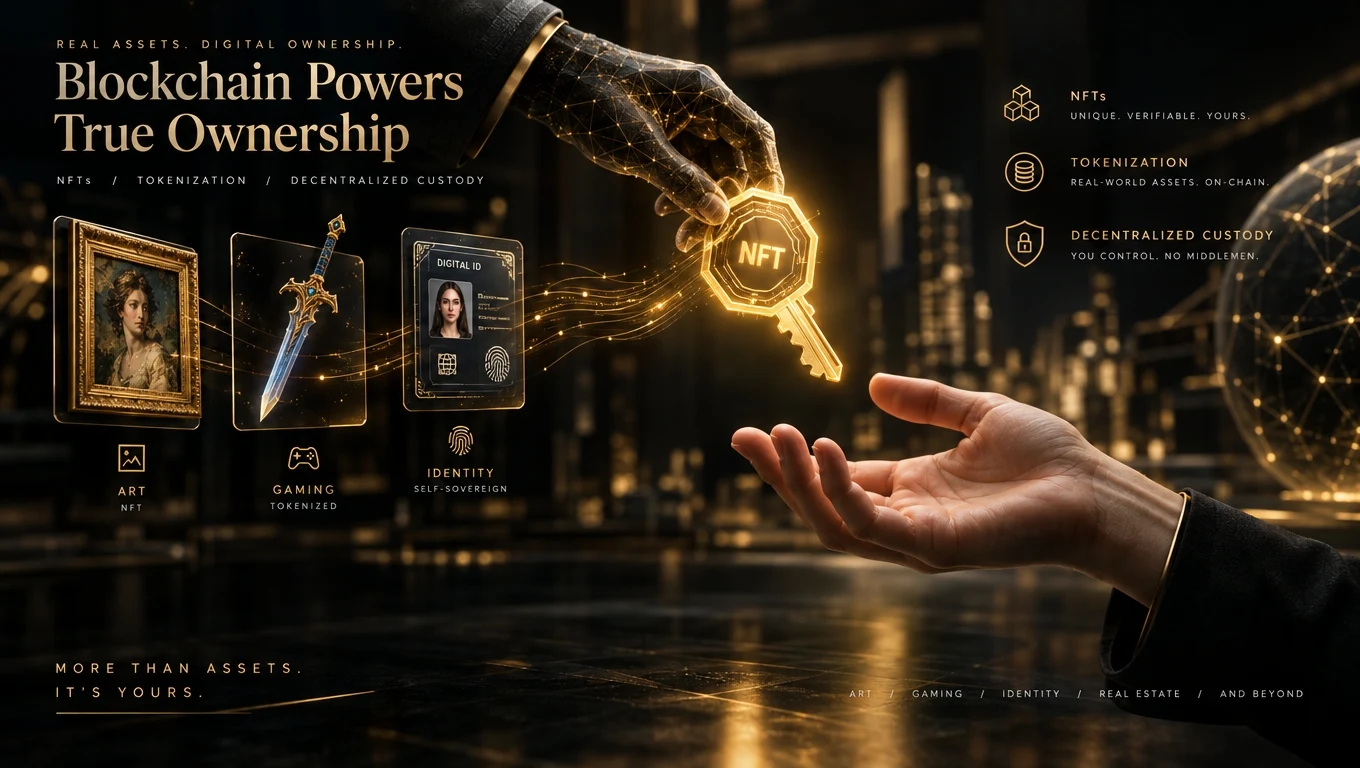
For most of the internet's history, "owning" something digital meant getting a license—you didn't actually own the music in your iTunes library, the items in your video game, or the photos on a social platform. Blockchain technology has fundamentally changed that equation by enabling genuine, verifiable, transferable digital ownership for the first time.
The Problem With Pre-Blockchain Digital Ownership
Before blockchain, digital assets had three critical weaknesses:
- Infinite reproducibility — files can be copied perfectly, infinitely, at zero cost
- Platform dependency — your purchases existed at the mercy of platform operators
- No native transferability — you couldn't sell or transfer your "owned" items to someone else
The result: digital things felt rented, not owned. iTunes accounts get locked. Game items disappear when servers shut down. Social media posts vanish when platforms ban users.
How Blockchain Solves Digital Ownership
Blockchain introduces four properties that traditional databases couldn't provide simultaneously:
- Scarcity — a token can be made provably unique or limited
- Provenance — every transfer is recorded immutably
- Self-custody — users control their assets via private keys, not platform accounts
- Composability — assets work across applications, not just within one platform
When combined, these properties create something fundamentally new: digital objects that behave like physical possessions while keeping the advantages of being digital. We go deeper into how verification actually works on-chain in our guide to digital ownership and verifiable assets.
Digital Ownership in Action
1. NFTs and Digital Art
Non-Fungible Tokens (NFTs) gave digital artists their first viable model for selling original works. Beeple's "Everydays" sold at Christie's for $69 million in 2021. Generative art platforms like Art Blocks have generated billions in cumulative sales for artists. CryptoPunks, despite cyclical market shifts, remain culturally significant collectibles.
Beyond hype cycles, NFTs solved a real problem: how do you sell a digital file that anyone could copy? By tying ownership to a blockchain-verified token rather than the file itself, artists could monetize digital scarcity for the first time—see the Picasso tokenization case study for how this now extends to fine art.
2. Bitcoin Ordinals
Ordinals, launched in 2023, inscribe content directly onto Bitcoin satoshis. Unlike Ethereum NFTs that often point to external storage, Ordinals embed the artwork in Bitcoin's most secure ledger. Over 80 million inscriptions exist by early 2026—a parallel ownership ecosystem with different aesthetic and technical priorities.
3. Gaming and Virtual Worlds
In-game items have always been valuable—the World of Warcraft economy was studied by economists for years. But traditional games kept ownership locked inside the game. Blockchain gaming enables genuine player ownership:
- Items can be sold for real value
- Assets work across multiple games (composability)
- Players can earn through gameplay (Axie Infinity at peak generated $1.3B in revenue)
The "play and own" model is replacing pure pay-to-play, with games like Illuvium, Star Atlas, and Pixels building on these foundations.
4. Tokenized Real-World Assets
Ownership extends beyond purely digital things. Tokenization is bringing physical assets on-chain:
- Real estate — RealT, Lofty, and Tangible let users own fractions of properties
- Art — Masterworks tokenizes blue-chip art for fractional investment
- Treasuries — BlackRock's BUIDL fund tokenizes U.S. Treasury exposure
- Carbon credits — Toucan and KlimaDAO bring environmental assets on-chain
Boston Consulting Group projects tokenized assets to reach $16 trillion by 2030.
5. Digital Identity
Self-sovereign identity (SSI) gives users portable, verifiable credentials they actually own. ENS names, World ID, and Microsoft's ION represent a fundamental shift from platform-controlled accounts to user-controlled identity.
6. Music and Media Royalties
Platforms like Sound.xyz, Royal, and Catalog let musicians sell ownership stakes in their songs directly to fans. Royalty distributions happen automatically via smart contracts. This circumvents traditional label structures that historically retained most ownership.
7. Domain Names
ENS (Ethereum Name Service) and Unstoppable Domains let users own their internet identity. Over 2 million .eth domains have been registered. Unlike traditional DNS, these names can't be revoked by a registrar.
The Mechanics: Why This Works
Three technical primitives make blockchain ownership possible:
Public-key cryptography — only the holder of a private key can transfer an asset. This replaces username/password authentication with cryptographic proof.
Distributed consensus — many independent nodes agree on the current state of ownership, removing single points of failure or control.
Smart contracts — rules around ownership (royalties, expiration, conditional transfers) execute automatically without intermediaries.
Real Challenges Still to Solve
Blockchain ownership isn't perfect:
- Key management — losing your private key means losing your assets permanently
- Off-chain dependencies — many NFTs still rely on external image hosting that could disappear
- Legal recognition — courts in most jurisdictions are still defining how blockchain ownership maps to traditional property law
- Royalty enforcement — secondary sale royalties for creators remain inconsistently enforced
- User experience — wallets, gas fees, and seed phrases still create friction
Account abstraction (ERC-4337), social recovery, and improved UX are addressing many of these issues, but progress varies by chain and application.
The Cultural Shift
The deeper change is philosophical. For the first time, internet users can actually own their digital existence:
- Your photos can live on Arweave rather than Instagram
- Your social graph can sit on Farcaster rather than Twitter
- Your music collection can be NFTs rather than streaming licenses
- Your professional credentials can be blockchain-verified rather than platform-locked
- Your identity can be a portable DID rather than a Google account
This shift doesn't mean every digital interaction needs blockchain. Plenty of things work better when centralized. But for digital objects worth owning—art, identity, valuable items, credentials, treasury assets—blockchain provides ownership properties that centralized systems fundamentally cannot match.
What's Next
Three trends will shape digital ownership through the rest of the decade:
- Mainstream tokenization of real-world assets brings traditional wealth onto blockchain rails
- Account abstraction and improved UX removes the technical barrier to ownership
- Cross-chain ownership lets assets move freely across blockchains as interoperability matures
Blockchain isn't just a financial technology—it's an ownership technology. And the implications for how we relate to digital things are still unfolding.
Disclaimer: Digital asset ownership carries technical and regulatory risks. Always practice secure key management and understand the legal framework in your jurisdiction.