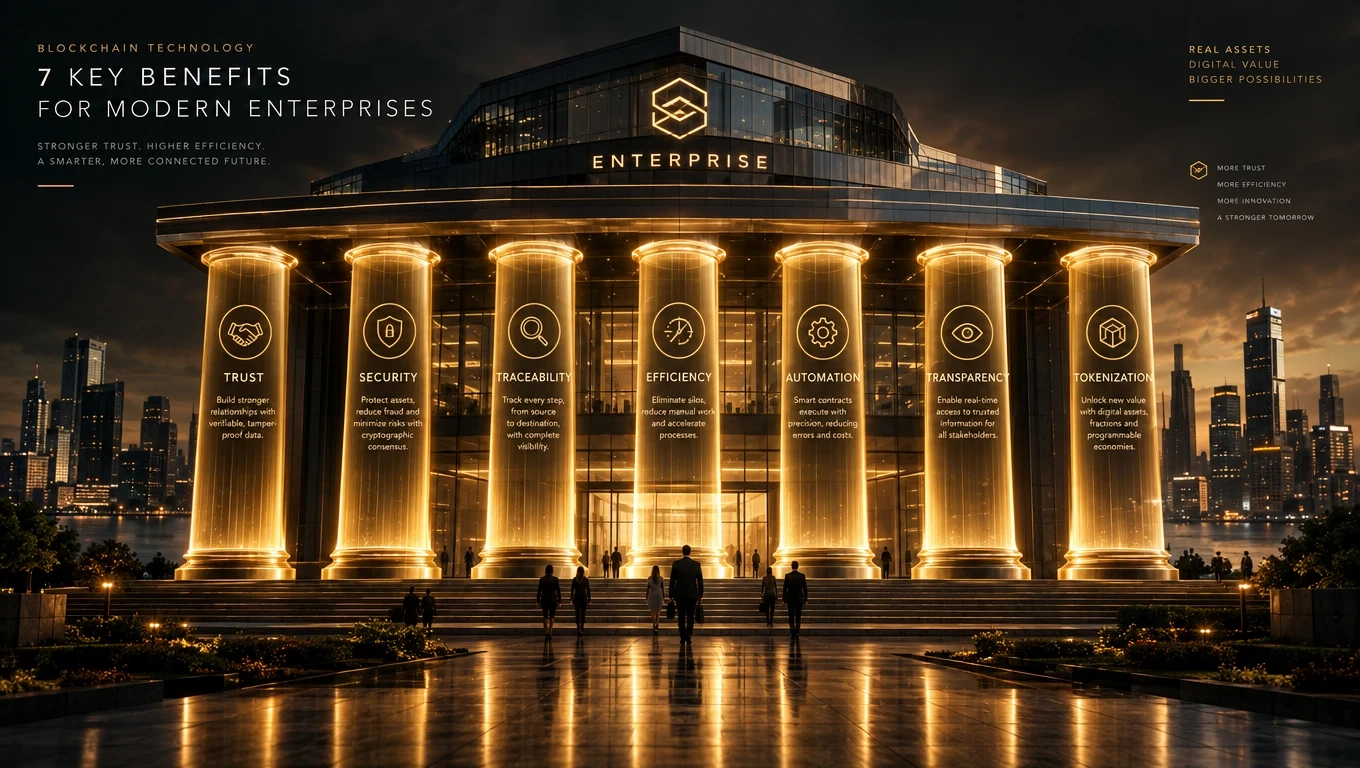
Blockchain technology has crossed the threshold from speculative novelty to operational infrastructure. By 2026, Gartner estimates that more than 30% of the global supply chain market is touched by some form of distributed ledger. For enterprises evaluating the technology, here are the seven most significant benefits—each backed by real implementations.
1. Enhanced Trust Among Business Partners
In multi-party business networks, trust is expensive. Every transaction requires reconciliation, audits, and dispute resolution. Blockchain creates a single, shared source of truth that all parties can verify independently. No one entity controls the data, yet everyone agrees on its state.
Example: The IBM Food Trust network reduced contamination traceback time at Walmart from 7 days to 2.2 seconds by giving every participant—farmers, processors, distributors, retailers—the same trusted view of provenance.
2. Improved Security Through Cryptography
Each block in a chain is cryptographically linked to the previous one. Altering historical data would require rewriting every subsequent block on every node simultaneously—computationally infeasible on networks like Bitcoin or Ethereum. This tamper-resistance makes blockchain particularly valuable for:
- Financial records
- Medical histories
- Legal contracts
- Identity credentials
According to IBM's 2024 Cost of a Data Breach report, organizations using blockchain-secured infrastructure experienced 27% fewer breach incidents than peers relying solely on traditional databases.
3. End-to-End Transparency
Every transaction on a public blockchain is visible to anyone. On permissioned chains, transparency is scoped to authorized participants. Either way, this visibility transforms how audits, compliance, and accountability work.
Real-world application: The LVMH-led Aura Blockchain Consortium lets luxury buyers verify the full lifecycle of a Louis Vuitton handbag—where the leather originated, when it was crafted, who owned it previously—directly from their smartphone.
4. Operational Cost Reduction
Eliminating intermediaries and automating reconciliation cuts operational costs significantly. McKinsey's research suggests blockchain can reduce trade finance processing costs by up to 50% and B2B cross-border payment costs by 40-80%.
Where the savings come from:
- Fewer reconciliation steps between parties
- Reduced fraud and chargeback losses
- Lower compliance overhead through automated audit trails
- Disintermediation of brokers and clearinghouses
5. Faster Transactions and Settlement
Traditional cross-border bank transfers take 1-5 business days. Stablecoin settlement on chains like Solana or Ethereum Layer-2s completes in seconds for cents in fees. JPMorgan's Onyx network now settles billions in repo transactions daily using blockchain, reducing settlement from T+2 to near-instant.
This speed advantage compounds across the financial system, freeing up trillions in working capital previously locked in settlement floats.
6. Traceability for Supply Chains
Blockchain creates an immutable audit trail from raw material to end consumer. For industries where provenance matters—pharmaceuticals, food, luxury goods, conflict minerals—this is transformative.
Examples:
- De Beers' Tracr tracks diamonds from mine to retail
- MediLedger verifies prescription drug authenticity to combat counterfeit medications
- Everledger has registered over 2 million diamonds and now extends to wine, art, and minerals
7. Programmable Automation via Smart Contracts
Smart contracts execute predefined logic automatically when conditions are met. This eliminates manual processing for routine transactions.
Real applications:
- AXA's parametric flight delay insurance auto-pays passengers when flights are delayed
- Aave's lending protocol automatically liquidates undercollateralized loans
- Tokenized real estate platforms automate rental income distribution to fractional owners
The Bank for International Settlements estimates programmable money could automate up to $4 trillion in annual global business processes.
Bonus: Tokenization of Real-World Assets
While not always listed among "traditional" benefits, tokenization is reshaping enterprise blockchain in 2026. BlackRock, Franklin Templeton, and Citi have all tokenized money market funds, treasuries, and private credit. Boston Consulting Group projects tokenized assets to reach $16 trillion by 2030—roughly 10% of global GDP.
Tokenization brings:
- 24/7 markets for traditionally illiquid assets
- Fractional ownership of high-value items (real estate, art, private equity)
- Faster settlement and reduced custody costs
- Global accessibility for retail investors
When Blockchain Isn't the Right Answer
Honest assessment matters. Blockchain isn't a universal solution. It excels when:
- Multiple parties need to share data without trusting each other
- An immutable audit trail is genuinely required
- Disintermediation creates measurable value
- Tokenization unlocks new market dynamics
It's overkill when:
- A single trusted entity controls the data
- Transaction volume requires database-tier speed (millions/second)
- Privacy requirements conflict with transparency
- Regulatory clarity is absent in your jurisdiction
For a fuller framework on where distributed ledgers genuinely outperform alternatives, see our review of blockchain benefits: transparency, trust, and security.
Getting Started With Blockchain in Your Enterprise
For organizations evaluating adoption:
- Identify a multi-party trust problem with measurable cost from intermediaries
- Choose the right chain — public (Ethereum, Solana) for openness, permissioned (Hyperledger Fabric, Corda) for enterprise control
- Start with a narrow pilot rather than a sweeping transformation
- Build for interoperability — assume cross-chain communication will matter
- Address regulatory compliance early — KYC, AML, and data privacy laws apply
The Bottom Line
Blockchain's benefits aren't theoretical anymore. From Walmart's food traceability to JPMorgan's instant settlement to LVMH's anti-counterfeit verification, distributed ledgers are delivering measurable ROI for enterprises that deploy them against the right problems. The question for business leaders in 2026 isn't whether blockchain works—it's where in your operations the technology unlocks the most value.
Disclaimer: This article is for educational purposes only. Enterprise blockchain implementations should involve qualified technical, legal, and compliance advisors.