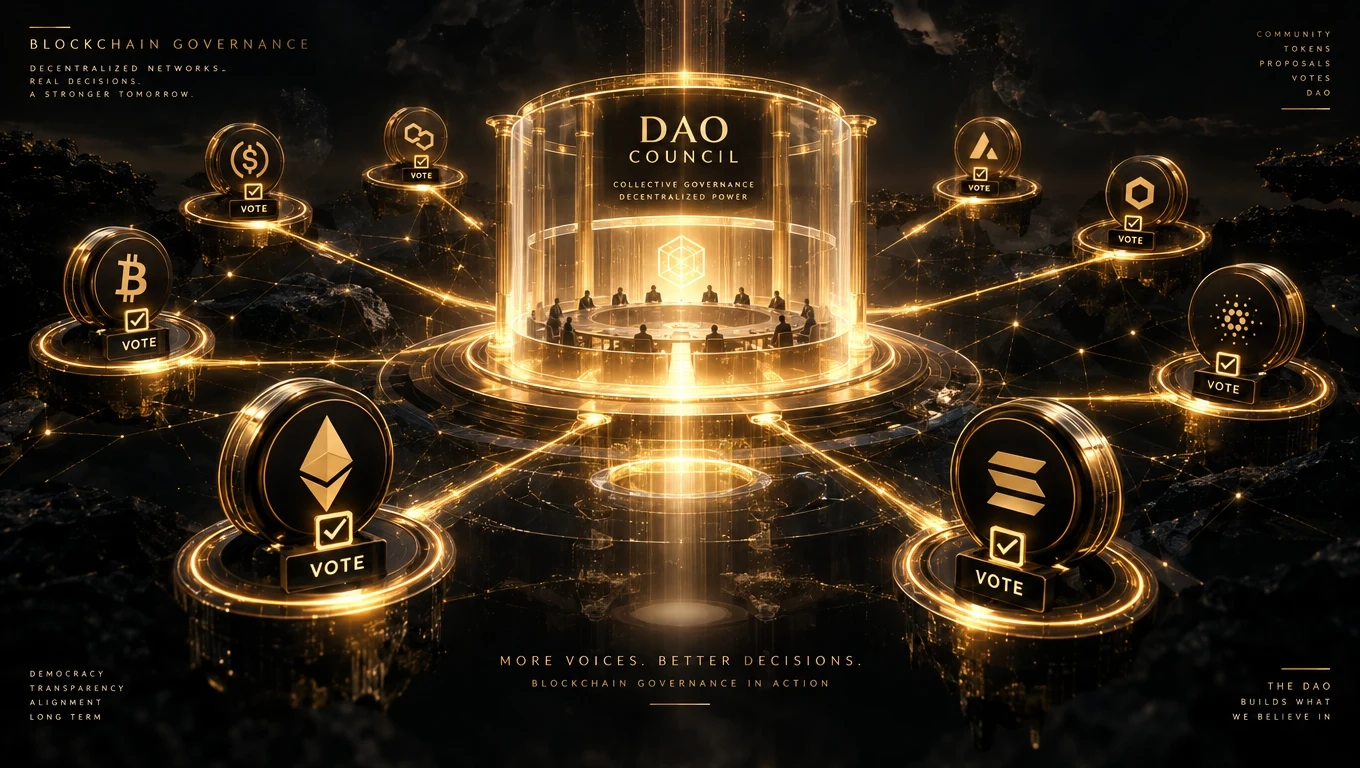
Blockchain governance is the framework that determines how decentralized networks evolve, upgrade, and resolve disputes without a central authority. As the Web3 ecosystem matures into 2026, governance has become the defining factor that separates resilient protocols from short-lived experiments.
What Is Blockchain Governance?
Blockchain governance refers to the rules, processes, and structures that let stakeholders—developers, validators, token holders, and users—coordinate decisions about a protocol's future. Unlike traditional corporate boards, these decisions happen transparently on a public ledger, where every vote and proposal is verifiable.
Governance exists in two complementary layers:
- On-chain governance: Voting and execution happen directly on the blockchain via smart contracts. Examples include Tezos, Polkadot, and MakerDAO.
- Off-chain governance: Decisions emerge from community discussion (forums, GitHub, social channels), then get implemented by core developers and node operators. Bitcoin and early Ethereum follow this model.
Why Governance Matters for Web3
Without effective governance, even technically brilliant blockchains stall. The 2016 Ethereum DAO hack, the Bitcoin block-size wars, and Terra's 2022 collapse all trace back to governance breakdowns. Strong governance delivers three measurable benefits:
- Protocol agility — networks can patch vulnerabilities and ship upgrades faster.
- Stakeholder alignment — token holders, validators, and developers share incentives.
- Regulatory legitimacy — transparent decision-making helps protocols engage with policymakers.
According to Messari's 2025 governance report, protocols with active on-chain voting saw 38% higher developer retention than those relying purely on informal coordination.
Core Models of Blockchain Governance
1. Token-Weighted Voting
The most common model: one token equals one vote. Compound, Uniswap, and Aave use this approach. It's simple but criticized for plutocracy—whales can dominate outcomes.
2. Delegated Governance
Token holders delegate voting power to representatives, similar to representative democracy. Polkadot's OpenGov and Cosmos Hub use delegation to reduce voter apathy while preserving accountability.
3. Quadratic and Conviction Voting
Newer models like Gitcoin's quadratic funding and 1Hive's conviction voting weight votes by the square root of tokens held, or by how long preferences are maintained. These mechanisms favor breadth of support over raw capital.
4. Multi-Signature and Council Models
Smaller protocols often start with a multisig "guardian council" before progressively decentralizing. Arbitrum and Optimism both use a Security Council as a safety net during their transition to full decentralization.
Governance via Blockchain: Beyond Crypto Protocols
The phrase "governance via blockchain" extends the concept outward—using distributed ledgers to improve governance in organizations, supply chains, and even public institutions.
- Corporate boards are piloting tokenized shareholder voting to reduce proxy fraud.
- Supply chains use blockchain to verify ethical sourcing and audit trails.
- Public sector experiments in Estonia, Switzerland, and the U.S. state of Wyoming have tested blockchain-based land registries, e-residency, and DAO LLC structures.
A 2025 World Economic Forum brief identified over 200 active public-sector blockchain governance pilots globally, up from just 46 in 2021.
Key Challenges Facing Blockchain Governance
Even well-designed systems face recurring problems:
- Voter apathy: Most token holders never vote. Compound proposals routinely see participation below 10% of circulating supply.
- Whale capture: Concentrated holdings can override majority sentiment.
- Bribery and vote buying: Markets like Curve's "bribe economy" show how voting power can be monetized—sometimes constructively, sometimes corrosively.
- Legal uncertainty: Regulators are still defining whether DAO governance tokens are securities, which affects who can participate.
Best Practices for Builders in 2026
Projects launching governance frameworks today should consider:
- Progressive decentralization: start with a multisig, transition to a DAO once the community matures.
- Time-locked execution: enforce a delay between vote approval and on-chain execution to give users time to react.
- Off-chain signaling first: use Snapshot or forum discussions before committing votes on-chain.
- Reputation systems: experiment with non-transferable "soulbound" tokens for governance weight, reducing pure plutocracy.
For a plain-English introduction to the same ideas, see our guide to decentralized governance with blockchain, and for the wider evidence, our multi-sector review of blockchain governance.
The Road Ahead
By 2026, governance has become a competitive differentiator. Networks like Arbitrum DAO ($3.5B+ treasury), Optimism Collective (Citizens' House + Token House bicameral system), and ENS DAO are pioneering hybrid models that blend on-chain voting with off-chain expertise. Expect AI-assisted proposal analysis, identity-verified voting (via decentralized IDs), and cross-chain governance coordination to define the next wave.
Blockchain governance is no longer a niche technical concern—it's how billions of dollars in protocol treasuries get allocated and how the internet's next infrastructure layer gets built. Understanding it isn't optional for anyone serious about Web3.
Disclaimer: This article is for informational purposes only and does not constitute investment or legal advice. Governance token participation may carry regulatory implications in your jurisdiction.