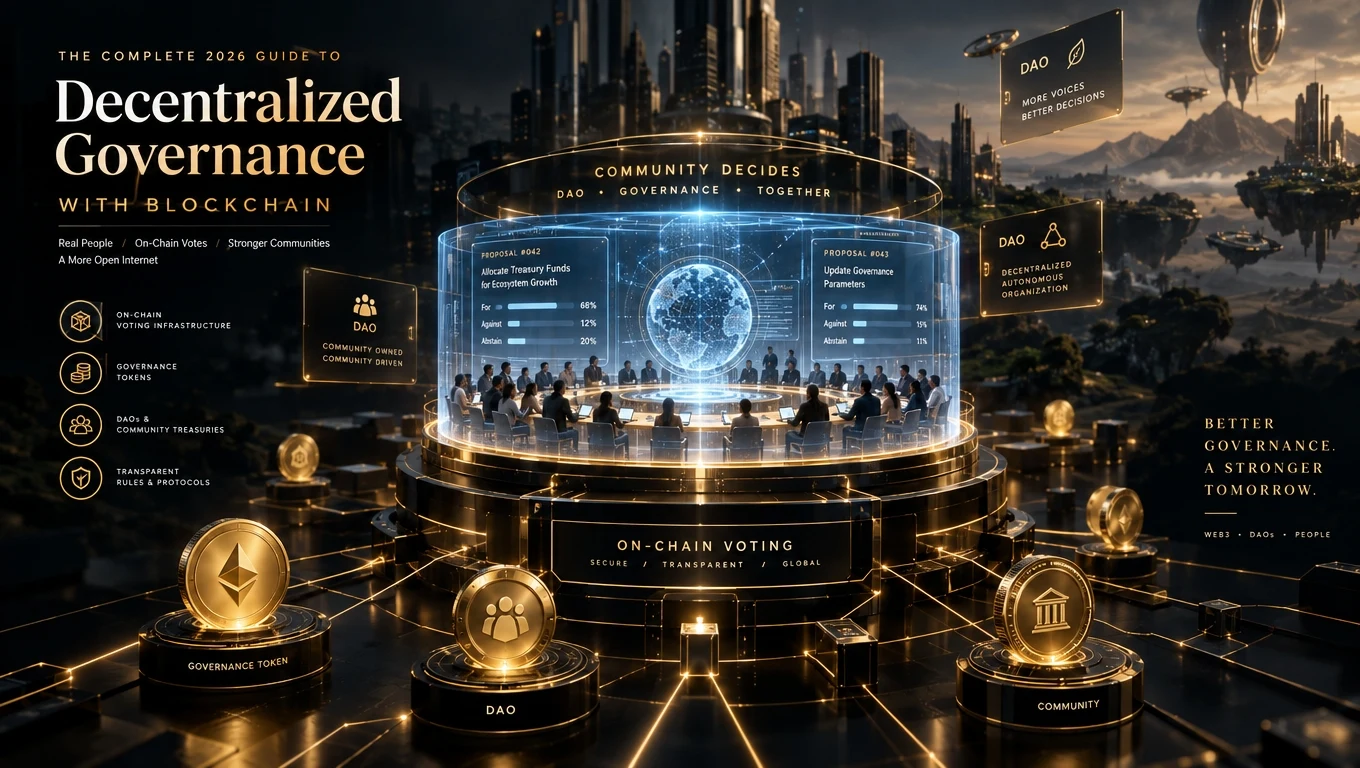
Decentralized governance is the practice of making collective decisions without a central authority—using blockchain technology to coordinate, vote, and execute outcomes transparently. By 2026, decentralized autonomous organizations (DAOs) manage billions of dollars in treasuries and increasingly serve as models for how communities, businesses, and even cities might organize themselves.
What Is Decentralized Governance?
Decentralized governance distributes decision-making power across a network of stakeholders rather than concentrating it in executives, boards, or government officials. Blockchain provides the infrastructure: transparent vote recording, automated execution via smart contracts, and tokenized representation of voting rights.
A typical decentralized governance flow looks like this:
- A community member drafts a proposal (off-chain discussion first)
- Token holders or designated voters cast votes on-chain
- If the proposal passes threshold requirements, smart contracts execute the outcome automatically
- Results are visible to everyone, forever
The key innovation: outcomes can't be reversed or manipulated by any individual party.
Why It Matters
Traditional governance—corporate boards, government agencies, member organizations—suffers from chronic problems: opaque decision-making, principal-agent conflicts, slow processes, gatekeeping, and corruption risk. Decentralized governance addresses these through:
- Transparency — every proposal, vote, and outcome is publicly auditable
- Inclusion — anyone holding tokens can participate, regardless of geography
- Automation — passed proposals execute without manual intervention
- Tamper resistance — vote records can't be altered after the fact
This isn't a panacea, but it's a meaningful upgrade for specific use cases.
The DAO Ecosystem in 2026
Several major DAOs now operate at significant scale:
Arbitrum DAO
The DAO that governs the Arbitrum Layer-2 network controls a treasury exceeding $3.5 billion in ARB tokens. It funds ecosystem grants, makes protocol upgrade decisions, and operates a Security Council as a safety mechanism.
Optimism Collective
Optimism pioneered a bicameral structure: a Token House (governance token holders) and a Citizens' House (humans verified via Worldcoin/Attestations). This blends capital-weighted and identity-weighted voting, addressing pure plutocracy concerns.
MakerDAO (now part of Sky Protocol)
The DAO behind the DAI stablecoin manages billions in collateral, sets interest rates, and approves new asset types—operating as a de facto decentralized central bank.
Uniswap DAO
Governs the largest decentralized exchange. Major decisions include treasury allocations, protocol fee structures, and grants to developers building on Uniswap.
ENS DAO
Governs the Ethereum Name Service. Decisions affect 2+ million registered names and the underlying identity infrastructure for much of Web3.
Aave, Compound, Lido, and others
DeFi protocols collectively governing tens of billions in user assets through token-based voting.
Models of Decentralized Governance
Token-Weighted Voting
One token equals one vote. Simple but creates plutocracy risk—whales can dominate outcomes. Used by Compound, Uniswap, Aave.
Delegated Voting
Token holders delegate to representatives. Reduces voter apathy while maintaining accountability. Polkadot's OpenGov, Cosmos Hub, and most modern DAOs support delegation.
Quadratic Voting
Vote weight equals the square root of tokens spent on voting. Favors broad support over capital concentration. Used by Gitcoin grants and increasingly explored for public goods funding.
Conviction Voting
Vote weight grows over time as preferences remain unchanged. Rewards long-term thinking. Used by 1Hive and several public goods funding DAOs.
Reputation-Based Voting
Non-transferable "soulbound" tokens grant voting power based on contributions rather than capital. Optimism's Citizens' House moves in this direction.
Multi-Sig Councils
Small groups (often 7-13 signers) hold execution power for sensitive decisions. Used by virtually every major protocol as a safety net during early decentralization phases.
For a plain-English walkthrough of how these mechanisms play out in practice, see decentralized governance with blockchain, explained, and for the protocol-level view, how decentralized networks make decisions.
Real Use Cases Beyond Crypto Protocols
Decentralized governance is expanding beyond pure crypto:
- Investment DAOs — MetaCartel Ventures, The LAO, and Komorebi Collective pool capital for venture investments
- Service DAOs — Raid Guild, MakerDAO Worker DAOs, and dOrg provide professional services
- Social DAOs — Friends With Benefits (FWB), Bored Apes Yacht Club governance
- Public goods DAOs — Gitcoin, Protocol Guild, Optimism RPGF distribute funding to open-source contributors
- Charity DAOs — Endaoment, Big Green DAO coordinate philanthropic giving
- Real-world experiments — CityDAO purchased Wyoming land; CabinDAO operates physical co-living spaces
- Science DAOs (DeSci) — VitaDAO funds longevity research; AthenaDAO funds women's health
Honest Challenges
Decentralized governance still faces real problems:
- Voter apathy — most token holders never vote. Many DAO proposals see participation below 10% of circulating supply.
- Whale capture — concentrated holdings can override majority sentiment.
- Sybil attacks — without identity, one person can pretend to be many.
- Coordination failure — DAOs struggle to make fast, complex decisions.
- Legal ambiguity — most jurisdictions haven't defined DAOs in law. Wyoming, the Marshall Islands, and a few others offer DAO LLC structures.
- Operational execution — DAOs are great at voting on direction but often poor at executing detailed implementation work.
Best Practices for Effective Decentralized Governance
Successful DAOs share common patterns:
- Progressive decentralization — start with multisig control, transition to community governance as the project matures
- Off-chain discussion before on-chain votes — Snapshot, Discourse, and Discord for deliberation; on-chain for binding decisions
- Time-locked execution — enforce a delay between vote approval and execution
- Specialized working groups — delegate operational details to smaller teams accountable to the DAO
- Clear constitution — written principles that guide what the DAO will and won't do
- Reputation systems — recognize long-term contributors beyond pure token holdings
- Security councils — emergency response mechanisms for protocol-threatening situations
The Outlook for Decentralized Governance
Three trends will shape the next phase:
- Identity-verified governance using zero-knowledge proofs and decentralized identifiers will reduce sybil risk without sacrificing privacy
- AI-assisted proposal analysis will help voters understand complex proposals
- Cross-chain governance will coordinate decisions across protocols deployed on multiple blockchains
Decentralized governance won't replace traditional institutions across the board. But for digital-native communities, open-source projects, and asset management protocols, it's becoming the default model. The DAOs governing billions in treasury and millions of users today are early prototypes for how networked organizations will operate at scale.
Disclaimer: Participating in DAO governance may have regulatory and tax implications. Always consult qualified advisors in your jurisdiction.