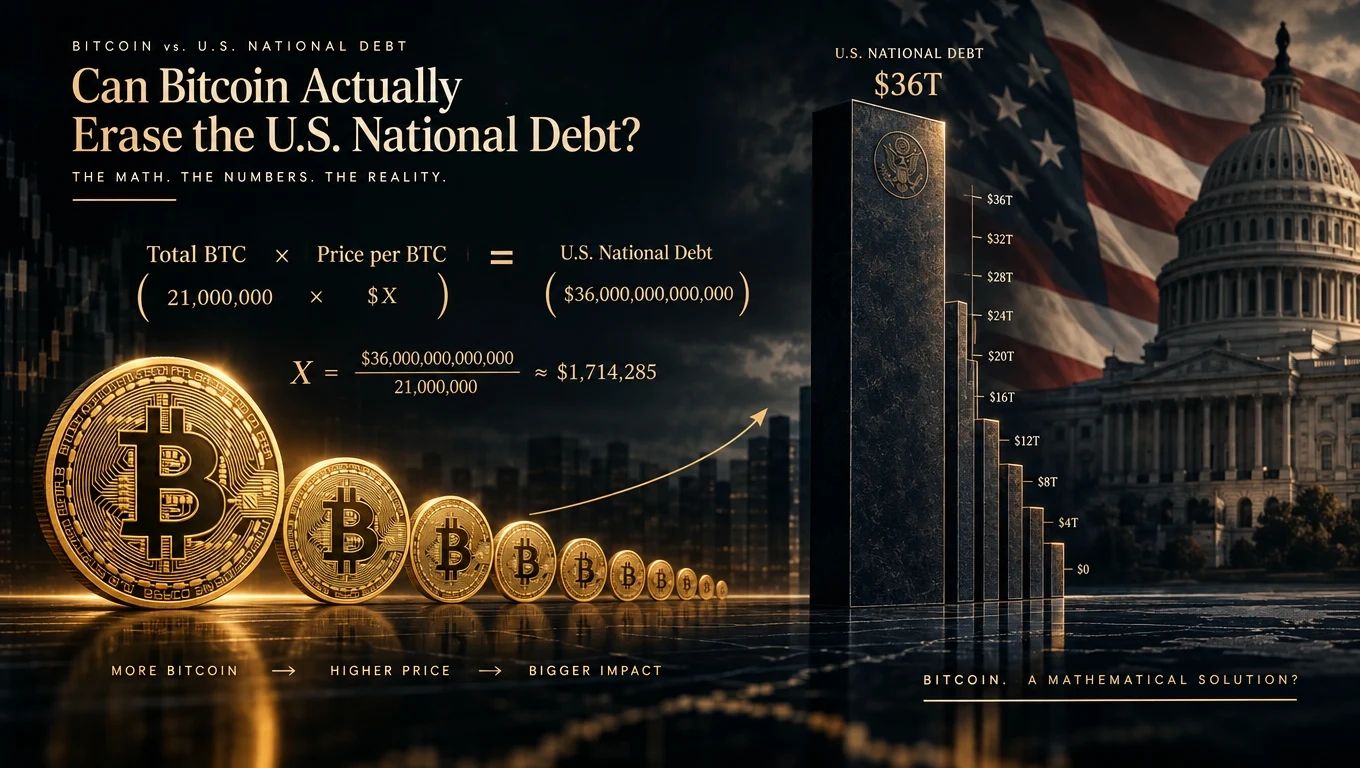
The U.S. national debt has crossed $38 trillion, and a provocative question is gaining traction in policy circles and among Bitcoin advocates: could a U.S. Strategic Bitcoin Reserve, sized aggressively enough, actually erase that debt? The answer requires real math, not just enthusiasm. Let's run the numbers.
The Basic Premise
The argument goes like this: the U.S. government holds approximately 200,000 BTC seized from criminal cases. If the government acquired more Bitcoin and held it long-term, sufficient price appreciation could theoretically offset national debt.
In 2025, Senator Cynthia Lummis proposed the BITCOIN Act, which would have the U.S. accumulate 1 million BTC over five years. Some advocates argue this would create asymmetric upside that could meaningfully reduce debt-to-GDP ratios. For a companion analysis of the treasury's existing holdings, see our piece on bitcoin and the U.S. national debt.
Running the Math
Scenario 1: Government holds 1 million BTC
If the U.S. acquired 1 million Bitcoin (roughly 5% of the eventual 21 million supply):
- At $1 million/BTC: reserve value = $1 trillion (covers ~2.6% of debt)
- At $10 million/BTC: reserve value = $10 trillion (covers ~26% of debt)
- At $38 million/BTC: reserve value = $38 trillion (covers 100% of debt)
For Bitcoin alone to erase the $38 trillion debt with a 1-million-coin reserve, each Bitcoin would need to reach $38 million.
Scenario 2: Government holds 3 million BTC
If the U.S. accumulated 3 million BTC (about 14% of total supply—politically unlikely but mathematically possible):
- Each Bitcoin would need to reach ~$12.7 million to cover $38 trillion
Scenario 3: Government holds 5 million BTC
At 5 million BTC (about 24% of total supply—essentially impossible without massive market disruption):
- Each Bitcoin would need to reach $7.6 million to cover the debt
What Would Drive Bitcoin to Those Levels?
For Bitcoin to reach $7-38 million per coin, several conditions would need to hold:
1. Global Reserve Asset Status
Bitcoin would need to capture a meaningful share of global savings currently held in gold, government bonds, and reserve currencies. Gold's total market cap is roughly $17 trillion. Sovereign bonds globally exceed $100 trillion. If Bitcoin captured even 10-20% of these flows over decades, prices in the $1-3 million range become plausible.
2. Dollar Devaluation
Aggressive money printing or sustained high inflation would push nominal Bitcoin prices higher even without real demand growth. This is essentially the inflationary path—debt is technically "paid off" but in devalued dollars.
3. Network Effect Adoption
If most central banks held Bitcoin in reserves (the way they hold gold today), and most large corporations carried Bitcoin on balance sheets, demand would compound. MicroStrategy already holds 250,000+ BTC; if even 100 large companies followed at similar scale, demand would significantly outstrip supply.
4. Technological Resilience
Bitcoin would need to remain secure, decentralized, and politically resilient over decades. This isn't guaranteed—quantum computing threats, regulatory hostility, or technical failures could derail any scenario.
The Hard Realities
Here's where pure math meets political and economic reality.
Reality Check 1: The Government Can't Easily Buy 1 Million BTC
Buying 1 million Bitcoin would represent roughly 5% of total supply. Such accumulation would dramatically push price up during purchases, making the average cost far higher than current prices. Game theory suggests other nations, corporations, and individuals would race to accumulate before the U.S., further driving prices.
Reality Check 2: Selling Becomes Impossible
If the U.S. ever needed to sell its Bitcoin reserve to actually pay debt, the sale itself would crater the price. A holder of 1 million BTC selling at scale could push prices down by 50% or more. The asset is worth $X trillion on paper only as long as you don't try to monetize it all at once.
Reality Check 3: Debt Is Denominated in Dollars
The U.S. national debt is in dollars. To pay it, you need dollars. Bitcoin would need to be sold for dollars—triggering tax implications, market impact, and political controversy. Alternatively, Bitcoin could collateralize debt rather than retire it.
Reality Check 4: Volatility Is Brutal
Bitcoin has experienced 70-80% drawdowns multiple times. A national reserve strategy must survive these without forced selling. Bhutan and El Salvador have managed it, but they're tiny relative to U.S. debt obligations.
Reality Check 5: Political Stability Over Decades
A sovereign Bitcoin strategy only works if successive administrations maintain it. A future government could sell the reserve at the bottom or ban Bitcoin entirely. Long-term sovereign Bitcoin accumulation requires constitutional or treaty-level commitments most countries haven't made.
A More Realistic Scenario
Rather than erasing debt, a U.S. Strategic Bitcoin Reserve could play a more modest but still valuable role:
- Diversifying reserves alongside gold and foreign currencies
- Hedging dollar inflation risk with a hard-capped asset
- Generating long-term capital gains that supplement tax revenue
- Strategic geopolitical positioning in a multi-polar reserve world
- Signaling commitment to digital financial infrastructure
If 1 million BTC accumulated at an average price of $300,000 grew to $1.5 million over 20 years, that's $1.2 trillion in unrealized gains—meaningful, but not debt-erasing.
What Bhutan and El Salvador Have Shown
Bhutan's roughly 13,000 BTC equals about 30% of its GDP—a remarkable diversification for a small economy. El Salvador's 6,000+ BTC is now worth nearly $1 billion against the country's annual GDP of ~$33 billion. These are proportionally large positions, generating real wealth.
The U.S. would need to hold Bitcoin at vastly larger scale to achieve comparable proportional impact—and the macro effects of such accumulation would reshape the global financial system in ways difficult to predict. For the full story of these two experiments, see how El Salvador and Bhutan won big on Bitcoin.
The Honest Conclusion
Could Bitcoin price reach $38 million per coin? Mathematically yes, if Bitcoin becomes the dominant global reserve asset over decades. Practically, the path requires sustained adoption, massive monetary debasement, or both—neither of which is guaranteed.
A more realistic framing: Bitcoin can become a meaningful component of national reserves, generating long-term gains that partially offset fiscal pressure. "Erasing" $38 trillion in debt is more rhetorical aspiration than near-term plan.
For investors, the question isn't whether Bitcoin will erase national debt. It's whether sovereign accumulation creates sustained demand pressure that benefits long-term holders. On that question, the trend lines from El Salvador, Bhutan, and the emerging U.S. Strategic Bitcoin Reserve suggest meaningful upside without requiring fantastical scenarios.
Disclaimer: This is analytical commentary, not financial advice. Bitcoin remains volatile and speculative. National debt dynamics involve complex factors beyond any single asset.