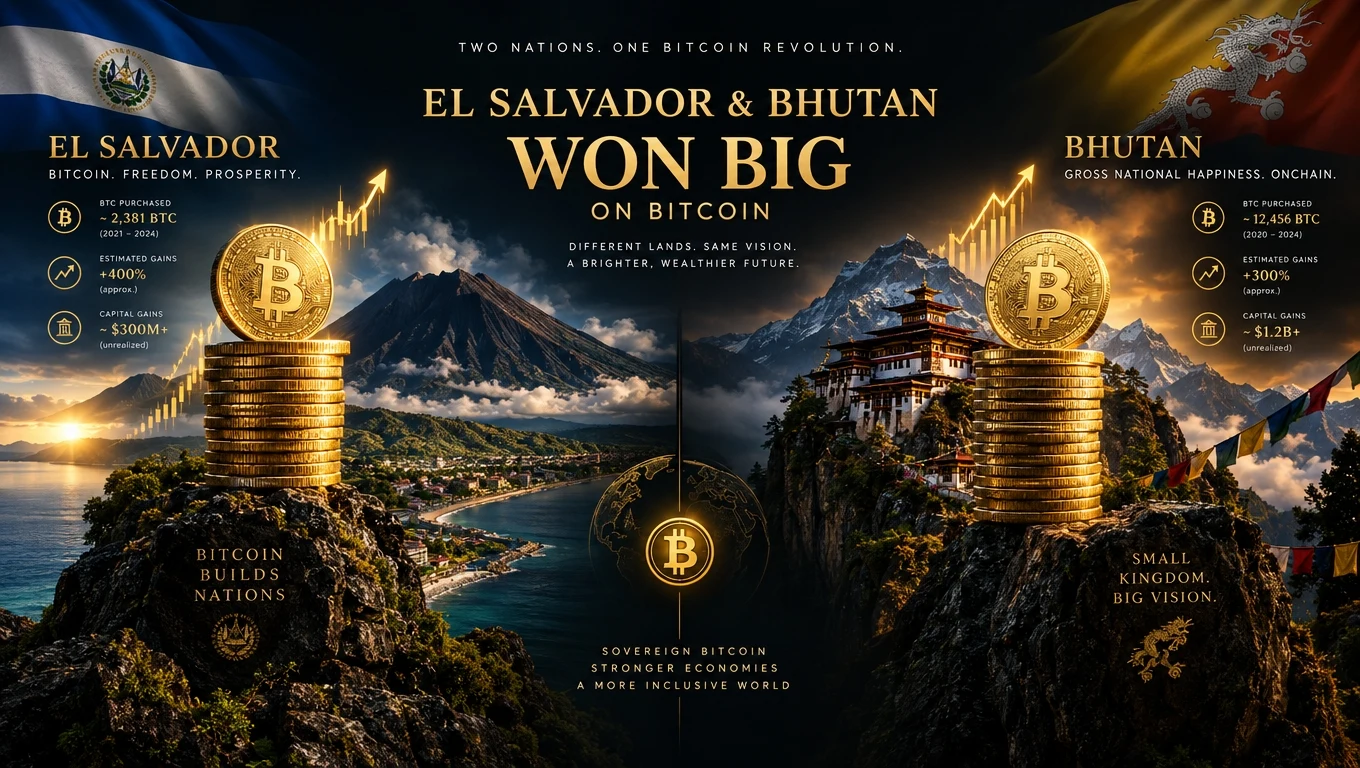
In a world where major economies hesitated to engage with cryptocurrency, two small nations took the plunge—and their results are reshaping the conversation about sovereign Bitcoin adoption. El Salvador and Bhutan approached Bitcoin from entirely different angles, but both have generated significant returns and global attention by 2026.
El Salvador: The Pioneer of Legal Tender
In September 2021, El Salvador became the first country to make Bitcoin legal tender. President Nayib Bukele's government rolled out the Chivo wallet, distributed $30 in BTC to citizens who registered, and began purchasing Bitcoin for the national treasury.
The decision sparked intense international debate. The IMF warned of financial stability risks. Credit rating agencies downgraded the country. Critics predicted disaster.
The Strategy
Bukele's government adopted a now-famous "1 BTC per day" purchasing strategy, accumulating Bitcoin through scheduled buys regardless of market conditions—essentially dollar-cost averaging at the sovereign level. Additional discretionary purchases happened during major price dips.
The Results by 2026
According to El Salvador's Bitcoin Office (Oficina Nacional del Bitcoin), the country holds over 6,000 BTC as of early 2026. With Bitcoin trading in six-figure territory, the treasury holds unrealized gains exceeding $400 million on an estimated cost basis around $270 million.
Beyond the treasury, broader economic effects include:
- Tourism surged — visitor numbers jumped over 80% from pre-adoption levels, with crypto-native travelers flocking to "Bitcoin Beach"
- Foreign investment — the country became a hub for crypto companies, mining operations, and Web3 conferences
- Remittance costs dropped for the 24% of GDP that flows in from Salvadorans abroad
- Bond market access — once frozen out, El Salvador returned to international debt markets with successful issuances in 2024 and 2025
The country reached a $1.4 billion deal with the IMF in late 2024 that softened some Bitcoin requirements while preserving the national strategy. Critics still note that domestic Bitcoin payment adoption among ordinary Salvadorans remains modest, but the macro-level wins are undeniable.
Bhutan: The Quiet Crypto Miner
While El Salvador made global headlines, Bhutan operated almost entirely in stealth. The small Himalayan kingdom—better known for its Gross National Happiness index than financial innovation—quietly built one of the most profitable sovereign Bitcoin operations in the world.
The Strategy
Bhutan's approach leverages its single greatest natural advantage: abundant, clean hydroelectric power. The country generates significantly more electricity than its 800,000 citizens consume, much of which historically went to waste during monsoon season surpluses.
Through its sovereign investment arm Druk Holding & Investments (DHI), Bhutan began mining Bitcoin using surplus hydropower, plus making strategic spot purchases. The operation only became public in 2023 when on-chain analysts traced large BTC holdings back to government-linked wallets.
The Results by 2026
Reports indicate Bhutan holds over 13,000 BTC—worth more than $1.2 billion at recent prices and representing roughly 30% of the country's GDP.
The economic implications are extraordinary:
- A nation of 800,000 people now ranks among the world's largest sovereign Bitcoin holders
- Mining revenues helped fund public sector salary increases during fiscal pressure in 2024
- Bhutan's renewable energy infrastructure has been monetized rather than wasted
- The country is exploring tourism, IT, and energy export expansion funded by crypto gains
Unlike El Salvador, Bhutan didn't make Bitcoin legal tender or push retail adoption. The strategy was purely treasury-focused: accumulate, hold, and let the asset appreciate.
The U.S. Joins the Sovereign Bitcoin Conversation
In 2025, the United States took its own historic step. The Trump administration's executive order established a Strategic Bitcoin Reserve, formalizing the holding of approximately 200,000 BTC already in federal possession from law enforcement seizures. Several U.S. states—Texas, Wyoming, Florida, and others—have proposed state-level Bitcoin reserves.
While the U.S. reserve is smaller as a percentage of the economy than El Salvador's or Bhutan's, the symbolic and signaling impact is enormous. Other G20 nations now openly discuss Bitcoin treasury policies that would have been politically impossible just three years ago. For the math on what such reserves can — and can't — achieve, see can Bitcoin erase the US national debt and the companion national debt analysis.
Lessons From the Sovereign Bitcoin Experiments
1. Energy + Hydro = Mining Advantage
Countries with surplus renewable energy (Bhutan, Iceland, Paraguay, parts of Norway) have a natural arbitrage opportunity. Excess electricity becomes a globally fungible, hard asset.
2. Treasury Diversification Works
Holding Bitcoin alongside gold, USD, and other reserves provides genuine diversification, particularly against dollar inflation risk. The Bitcoin Office in El Salvador is structured similar to a sovereign wealth fund.
3. Adoption Doesn't Require Mandates
Bhutan never mandated Bitcoin usage. The wealth came from passive accumulation and mining. This suggests sovereign Bitcoin policy can succeed without forcing the technology onto citizens.
4. Volatility Is a Feature for Long Time Horizons
Both nations weathered the 2022 crypto winter without selling. Sovereign actors with long time horizons can endure drawdowns that retail investors and short-term institutions cannot.
5. Geopolitical Signaling Matters
By moving early, El Salvador and Bhutan attracted attention, talent, and capital from the global crypto industry. First-mover positioning has measurable economic value.
The Risks Are Still Real
This isn't a guaranteed playbook. Bitcoin's volatility means a 50%+ drawdown remains possible. A sustained bear market could erode sovereign holdings. Currency mismatches between Bitcoin reserves and local-currency obligations create accounting and political challenges. And regulatory shifts in major markets could affect liquidity.
But the data so far validates the thesis. Two small nations took an asymmetric bet, and as of 2026, that bet is paying off in measurable currency reserves, tourism, foreign investment, and global influence.
For other small or mid-sized nations watching from the sidelines, the question is no longer whether sovereign Bitcoin adoption is feasible—it's whether they can afford to keep waiting. And for the broader question of what crypto does for economies, see how cryptocurrencies drive economic growth.
Disclaimer: Sovereign-level crypto strategies don't necessarily translate to individual investment decisions. Cryptocurrency remains volatile and speculative.